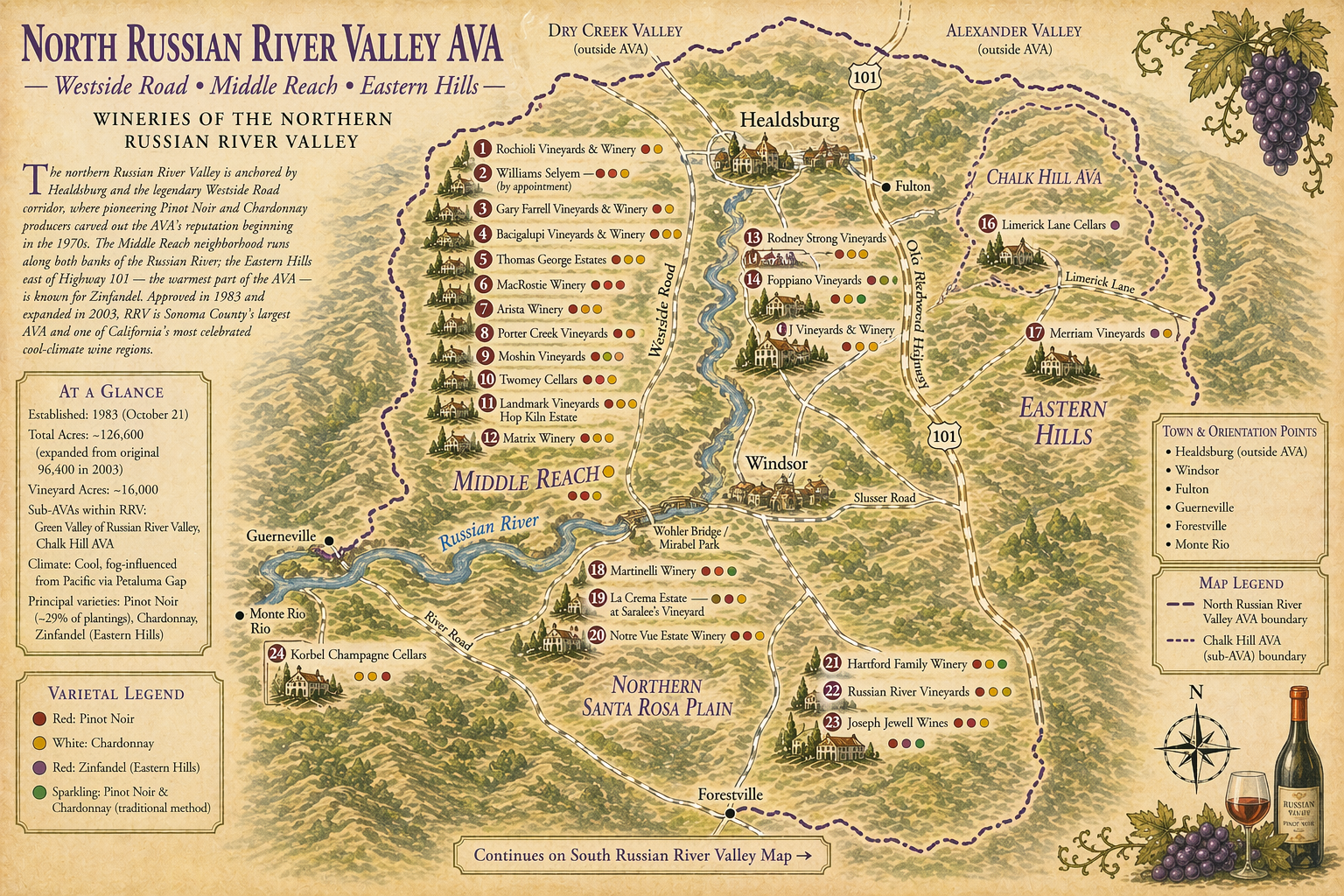
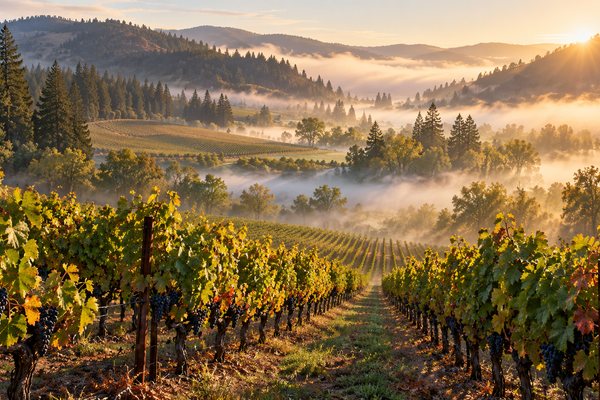
North Russian River Valley occupies the upper portion of the appellation, stretching from the outskirts of Healdsburg south to just above Forestville. This is where Russian River Valley's modern reputation was built: the Westside Road corridor beginning in the 1970s, where pioneering Pinot Noir and Chardonnay producers established the appellation's identity, and the Middle Reach neighborhood along both banks of the river where Rochioli, Williams Selyem, Gary Farrell, and Bacigalupi set the benchmark for cool-climate California winemaking. The valley floor here receives daily marine fog through the river corridor and from the Petaluma Gap to the south, but the Eastern Hills east of Highway 101 sit above the fog line and represent the AVA's warmest vineyards, a historic Zinfandel zone that predates Pinot Noir's arrival.
Soils across the north are a mix of Goldridge sandy loam on the western benches and alluvial gravels along the river corridor, with volcanic and clay influence on the Eastern Hills. The combination of diverse soils and the river-moderated climate produces a remarkable range of styles within a single neighborhood: fine-boned Pinot Noir from Westside Road, richer and more textured wines from Middle Reach, and structured old-vine Zinfandel from the Eastern Hills. Producers like Rochioli, Williams Selyem, Rodney Strong, Hartford Family, and J Vineyards have made this stretch of the valley one of the most collected addresses in American wine.
Tasting fees are per person: $ under $25 · $$ $25–50 · $$$ $50–100 · $$$$ $100+. Reserve and seated experiences may run higher.
The Bacigalupi family has farmed Westside Road since 1956, when Charles and Helen, a dentist and pharmacist, bought the Goddard Ranch. Their 1964 Wente-clone Chardonnay went into the 1973 Chateau Montelena that won the 1976 Paris Tasting. The estate label launched in 2011; four generations farm under winemaker Ashley Herzberg.








View Editorial
Founded in 1989 by Walt and Joan Flowers, who left their Pennsylvania horticulture business to pioneer viticulture on the Sonoma Coast. Their Camp Meeting Ridge and Sea View Ridge vineyards, high on ridges near the Pacific, were considered too cold by most; they proved otherwise. Hosted at the House of Flowers in Healdsburg.




View Editorial
Founded in 1982 by Gary Farrell, Davis Bynum's winemaker from 1978 and a Rochioli collaborator, who built the glass-walled winery on a Westside Road hillside in 2000. Owned since 2011 by Bill Price (Three Sticks, Durell, Gap's Crown) and Vincraft. Winemaker Brent McKoy, at the winery since 2005, leads the cellar.



View Editorial

Chris and Piper Underwood's 36-acre Westside Road estate, bought in 2025, is named for Reuben Harper, who farmed hops here in the 1850s. Winemaker Vance Rose makes Pinot Noir and Chardonnay from the estate and the Moon Dust vineyard in the Sebastopol Hills. Open daily in summer; reservations encouraged, walk-ins welcome.


View Editorial
Founded in 1974 by Damaris Deere Ford, great-great-granddaughter of John Deere, Landmark is best known for Burgundian-varietal whites and Pinots. The Russian River tasting room at Hop Kiln Estate, acquired in 2016, occupies a 1905 stone hop kiln on Westside Road, California Historical Landmark No. 893.
View Editorial
Joe Rochioli Sr. came to Westside Road in 1938, and son Joe Jr. planted the seminal West Block of Pinot Noir in 1968, among the first Pinot vines in the Russian River. Founded as a winery in 1976, Rochioli is run today by third-generation winemaker Tom Rochioli and his family. Allocation only.
View Editorial
Founded in 1999 by the Duncan family of Silver Oak, Twomey grew beyond Cabernet into Pinot Noir and Sauvignon Blanc from cool-climate sites from Santa Maria Valley to Anderson Valley. The Westside Road tasting room sits on a 109-acre Russian River estate. Ryan Hodgins leads the winemaking. Seated tastings by reservation.


View Editorial
Started by amateur winemakers Burt Williams and Ed Selyem in a Fulton garage, with first labels in 1979, Williams Selyem became the most coveted Pinot Noir mailing list by the mid-1990s. Burgundy’s Faiveley family has held majority ownership since 2024, and Jeff Mangahas has led the cellar since 2014.


View Editorial
A small Latina-owned family estate on the volcanic hillsides above Santa Rosa, in the Fountaingrove District AVA. Winemaker Belén Ceja produces about 1,500 cases a year, anchored by an estate Cabernet Sauvignon with Chardonnay, Sauvignon Blanc, rosé of Cabernet, and a Bordeaux-style red blend. Poured from Bacchus Landing in Healdsburg.

Founded in 1965 by Davis Bynum, the first winery on Westside Road. Bynum bottled the first single-vineyard Russian River Pinot Noir, the 1973 Rochioli, and helped establish the appellation. Sold to the Klein family in 2007, with winemaker Greg Morthole leading since 2010. Tastings now pour at Rodney Strong.

View Editorial
Founded in 1896 by Giovanni Foppiano, a Genoa Gold Rush immigrant. The family survived Prohibition selling winemaking kits; a 1926 raid dumped 100,000 gallons into a creek. In 1967 Louis J. Foppiano released the winery's first Petite Sirah bottling, the house's longtime anchor. Owned by Courtney Benham's CMB Wines since 2024.
Rodney D. Strong founded Sonoma County's 13th bonded winery in 1959; the Klein family has owned it since 1989. Twelve estate vineyards across five appellations anchor a serious single-vineyard program: Alexander's Crown, Rockaway, and Brothers Ridge Cabernet lead the Alexander Valley wines. Justin Seidenfeld leads winemaking.

Founded in 2001 by David Cobb and his son Ross. The Coastlands Vineyard, planted in 1989 on a Sonoma Coast ridge above Occidental, supplied Williams Selyem from 1992; Ross now farms it himself. The family makes single-vineyard Pinot Noir from three estate sites and partners, Chardonnay, and a little Riesling.
View Editorial
David Hirsch planted his ridge above Fort Ross in 1980, among the first to see that extreme coastal sites could grow great Pinot Noir. The estate is now regarded as the birthplace of the true Sonoma Coast style, a 72-acre vineyard along the San Andreas Fault. Daughter Jasmine now leads.

View Editorial
Founded by Baron Ziegler (also of Banshee Wines) and winemaker Rob Fischer, Marine Layer opened its downtown Healdsburg tasting room in 2021. The label sources Pinot Noir and Chardonnay from cool, fog-influenced Sonoma Coast sites: Petaluma Gap, Gap's Crown, Sebastopol Hills, Green Valley, Occidental, and the estate Marine Layer Vineyard.

View Editorial
Founded in 1996 by veteran winemaker David Ramey and Carla Ramey after his years at Simi, Matanzas Creek, and Chalk Hill, the label is known for low-intervention Burgundian Chardonnay and Bordeaux-influenced Cabernet. Now run by their children, Claire and Alan Ramey, co-presidents since 2021. Tasting room on Healdsburg Avenue.
The Rockpile AVA has no public tasting infrastructure, so the Wilson Artisan Wineries family brought the wines down off the mountain. The lounge sits in downtown Healdsburg, steps from the Plaza, pouring Rockpile-AVA flights from the 800-acre mountaintop ranch above Lake Sonoma. Zinfandel-driven, with Bordeaux and Petite Sirah folded in.
View Editorial
Phil and Sylvia Hurst founded Truett Hurst in 2007 in Dry Creek Valley on a biodynamic ethos. After its public-company years ended with the sale of the original property, Phil repurchased the brand in 2024 with vintner Ken Wilson. The winery now pours from the Hudson Street Tasting Barn in downtown Healdsburg.
Founded in 1882 by Czech immigrants Francis, Anton, and Joseph Korbel, the Guerneville estate has been the Heck family's home since 1954. One of America's oldest operating sparkling-wine houses, Korbel sits on 600 acres along the lower Russian River, its brick winery and rose garden listed on the National Register.

Three sisters founded Breathless as a tribute to their mother, crafting méthode champenoise sparkling wine just off the Healdsburg plaza. Winemaker Penny Gadd-Coster guides the cuvées, poured as seated flights in an Art Deco tasting room built from reclaimed shipping containers, with sabrage lessons and a garden patio.
View Editorial
View Editorial
Albini Family Vineyards is one of Sonoma's smallest bonded operations, a Windsor family estate making 275 to 500 cases a year of unfiltered Merlot and Zinfandel from their Russian River vineyards. Don and Lynne Albini do every step by hand. The most uncompromised garagiste experience in the county.
View Editorial
Founded by the Hanson family in 2017; 'bricoleur' is French for a handyman who builds something thoughtful from what's at hand. Tom Pierson was promoted to winemaker in late 2025 and leads the cellar with winemaker Bob Cabral. Pond-side pavilions, bocce, and gardens surround the Rooted food-and-wine pairing. Reservations recommended.

The Martinelli family has farmed the Russian River Valley since Giuseppe and Luisa Martinelli planted vineyards in the late 1800s, after emigrating from Tuscany. Today the family makes Pinot Noir, Chardonnay, Zinfandel, and Syrah from estate vineyards including the legendary 60-degree Jackass Hill Zinfandel block. Tasting room on River Road.
A 710-acre estate straddling North Russian River Valley and Chalk Hill, with 350 acres preserved as Forever Wild. Grapes have grown here since 1869, and the property was established as Balverne Cellars in 1972; Bob and Renée Stein acquired it in 1992. Block 23 Terrace and Lakeside Pavilion overlook the vines.
Oops! Something went wrong while submitting the form