Mendocino

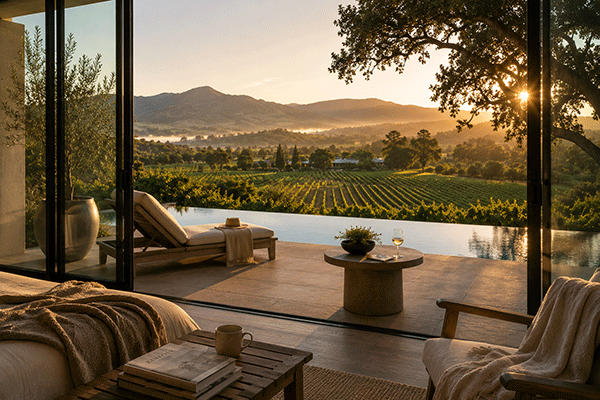
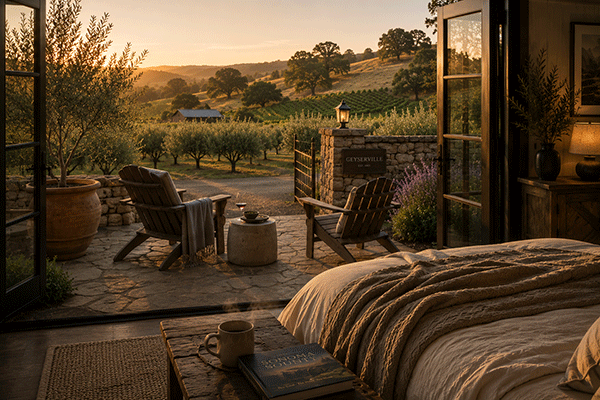
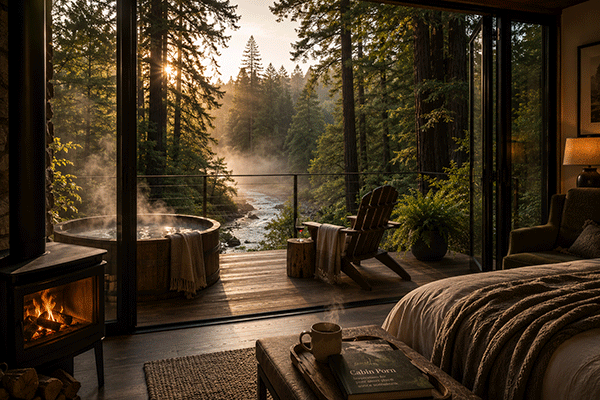
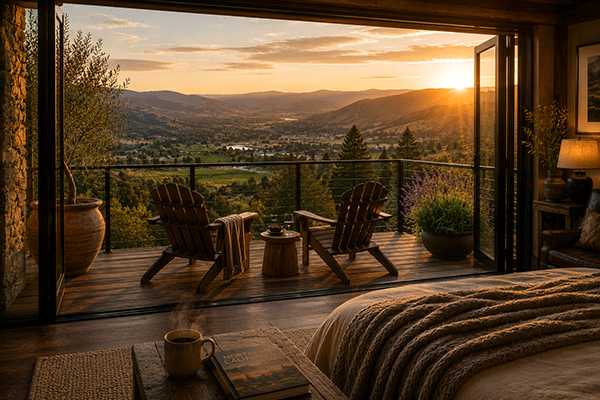
Mendocino County is defined by its rugged coastline, dense forests, and a sense of distance that shapes both its landscape and its dining culture. Here, agriculture exists alongside wilderness, and the connection to land and sea feels immediate and unfiltered. Small farms, fisheries, and producers operate with a strong sense of independence, supplying restaurants that prioritize seasonality and simplicity. The result is a culinary identity rooted less in refinement and more in authenticity, where place and process guide what arrives at the table.

Read more

The diversity of Mendocino’s terrain creates a natural variation in its food and wine. Along the coast, cool climates and maritime influence support delicate varietals and a lighter, more restrained approach to cooking, often centered on seafood and foraged ingredients. Inland, warmer valleys and open land yield more robust agricultural products, reflected in both the wines and the dishes that accompany them. Restaurants across Mendocino reflect this range. Some are deeply tied to local traditions, others shaped by newer, independent perspectives, yet the most compelling share a commitment to sustainability, seasonality, and place. In Mendocino, dining is not driven by occasion or spectacle—it is grounded in the rhythms of the land, where food remains closely tied to its source.

Restaurants

Local Terroir Distinctions
No items found.
No items found.

Sunny Side Up

No place is ever as bad as they tell you it’s going to be.
No items found.

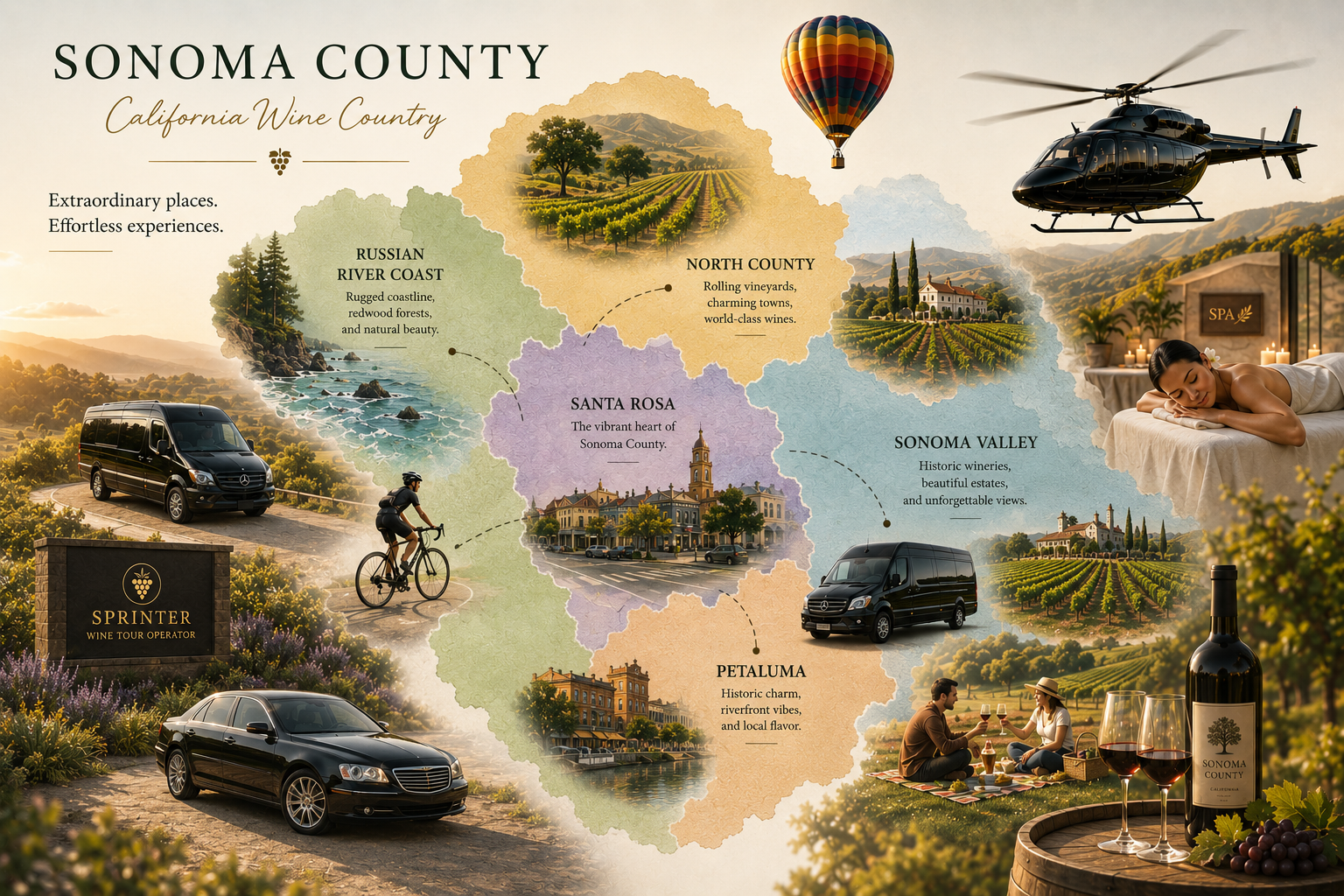
AVAs — American Viticultural Areas

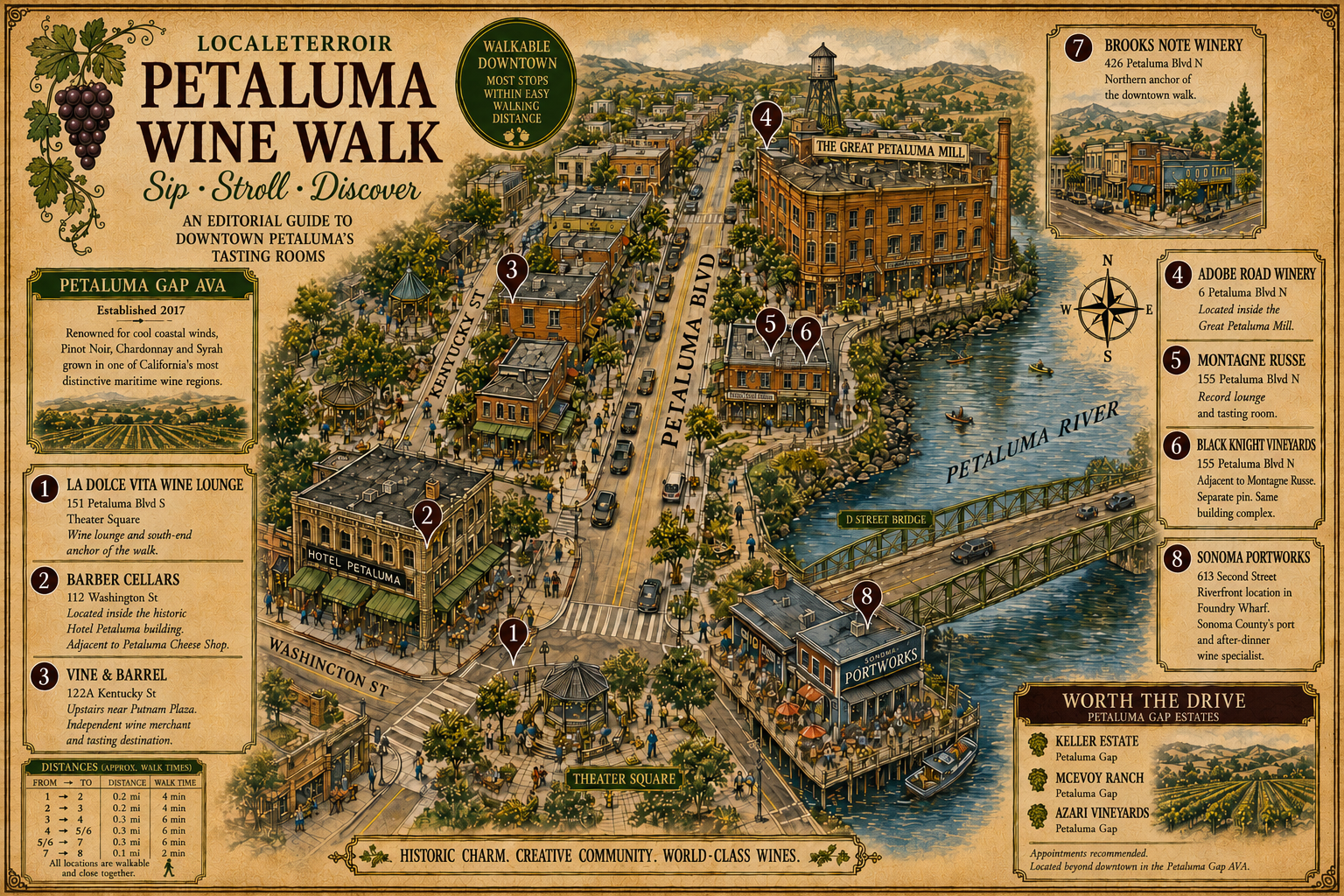
Established 2017 · Thermal wind corridor · Breach in Coast Range between Bodega Bay and San Pablo Bay · Wind-defined appellation · Silty clay loam and volcanic soils · Pinot Noir · Syrah · Petaluma and Sonoma County

Established 2023 · Narrowly defined coastal AVA · Only vineyards genuinely shaped by Pacific Ocean proximity qualify · Rocky ancient soils · Temperatures rarely exceed 70°F · Pinot Noir · Chardonnay · Occidental, Freestone, Bodega Bay area

Established 2012 · Coastal ridges 1,200–2,200 ft elevation · Above the fog line · Dramatic 50°F+ diurnal range · Thin rocky ancient soils · Pinot Noir · Chardonnay · Jenner and Cazadero area, Sonoma County

Established 1983 · Sonoma County · Healdsburg to Forestville · Westside Road · Middle Reach · Eastern Hills · Goldridge sandy loam, alluvial gravels, volcanic soils · Pinot Noir · Chardonnay · Zinfandel (Eastern Hills)

Established 1983 · Sub-AVA of Russian River Valley · Forestville and Graton area · Coldest and foggiest corner of RRV · Goldridge sandy loam soils · Shortest growing season in Sonoma · Pinot Noir · Chardonnay · Sparkling wine

Established 1983 · Sonoma County · Green Valley sub-AVA · Laguna Ridge · Sebastopol Hills · Santa Rosa Plain · Goldridge sandy loam · Coolest, foggiest corner of RRV · Pinot Noir · Chardonnay · Sparkling

Established 1983 · Enclosed valley between three ridgelines · Volcanic soils · Petaluma Wind Gap influence · Merlot · Syrah · Chardonnay · Santa Rosa, Sonoma County

Established 1983 · Northeastern edge of Russian River Valley · White volcanic ash soils · Warmer and more sheltered than RRV proper · Chardonnay · Sauvignon Blanc · Cabernet Sauvignon · Windsor area, Sonoma County

Established 1981 · Sonoma County's first AVA · Runs northwest-southeast from San Pablo Bay to Kenwood · Diverse elevations 0–2,000+ ft · Volcanic and alluvial soils · Cabernet Sauvignon · Zinfandel · Chardonnay · Pinot Noir

Established 2013 · Western slopes of Mayacamas Range · Elevations 400–2,000+ ft · Above the Sonoma Valley fog line · Ancient volcanic soils · Dramatic diurnal range · Cabernet Sauvignon · Zinfandel · Sonoma Valley, Sonoma County

Established 1985 · Western edge of Sonoma Valley · Above the marine fog line · Ancient volcanic soils · Warm days, cool nights · Cabernet Sauvignon · Zinfandel · Merlot · Glen Ellen and Kenwood area, Sonoma County

Established 1983 · 16 miles long, 1 mile wide · Benchland alluvial soils · Zinfandel and Sauvignon Blanc dominant · Old-vine heritage · Northwest of Healdsburg

Established 1984 · 22-mile valley · Russian River corridor · Warm to hot climate · Cabernet Sauvignon and Merlot dominant · Old-vine Zinfandel heritage · Healdsburg to Cloverdale

Established 1983 · Sonoma County · Warmest AVA in Sonoma · Volcanic and alluvial soils · Cabernet Sauvignon dominant · Borders Napa Valley to the east

Established 2015 · Volcanic hillsides above Santa Rosa · Elevations 400–2,000 ft · Above the marine fog line · Thin rocky volcanic soils · Named for 19th-century utopian community · Rebuilt after 2017 Tubbs Fire · Cabernet Sauvignon · Merlot · Cabernet Franc

Established 2002 · Nation's 145th AVA · Sonoma's 12th · ~160 acres planted across 11 vineyards · Elevation 800–2,100 ft · Zinfandel dominant · Above Lake Sonoma · Northwest corner of Dry Creek Valley

Established 2012 · Sonoma-Mendocino border · Elevations 1,600–2,700 ft · Volcanic soils · Cabernet Sauvignon and Bordeaux blends dominant · Extreme diurnal range

Large umbrella AVA · Pacific Ocean-defined · Sub-regions: Fort Ross-Seaview, West Sonoma Coast, Petaluma Gap, Green Valley · Pinot Noir and Chardonnay dominant · Coolest growing conditions in Sonoma

Stay in Touch

Thank you! Your submission has been received!

Oops! Something went wrong while submitting the form