Monterey wine country runs along the inland edge of the central coast, where the Salinas Valley's cool maritime air sweeps in through the Monterey Bay opening and shapes one of California's most distinctive cool-climate growing regions. The Santa Lucia Highlands AVA, perched on east-facing benches above the valley floor, has earned a reputation among critics and collectors for some of the country's most expressive Pinot Noir and Chardonnay—names like Pisoni, Hahn, Mer Soleil, and Talbott's Sleepy Hollow vineyard anchor an appellation taken seriously by the wine world. South and east, the Carmel Valley AVA produces structured Bordeaux varieties at producers like Bernardus and Joullian, while the historic Chalone AVA near the Pinnacles continues a tradition that dates to the 1960s. Together these appellations form a wine country distinct from the coastal tourism corridor of Carmel-by-the-Sea, Monterey, and Big Sur.
Read moreThe dining culture that has grown around these vineyards reflects the agricultural identity of the Salinas Valley—one of the most productive farming regions in the country—and the proximity to Monterey Bay's deep cold-water fisheries. Carmel Valley Village's tasting-room corridor anchors a constellation of restaurants where local sourcing is direct and immediate, often by name. In Salinas, Soledad, and the small ag-belt towns along Highway 101, dining is more grounded, shaped by the rhythm of harvest. Restaurants across Monterey wine country lean toward ingredient-driven cooking and quiet refinement—less spectacle than Napa, less destination polish than Carmel-by-the-Sea, and tied closely to the wines that share the same land.

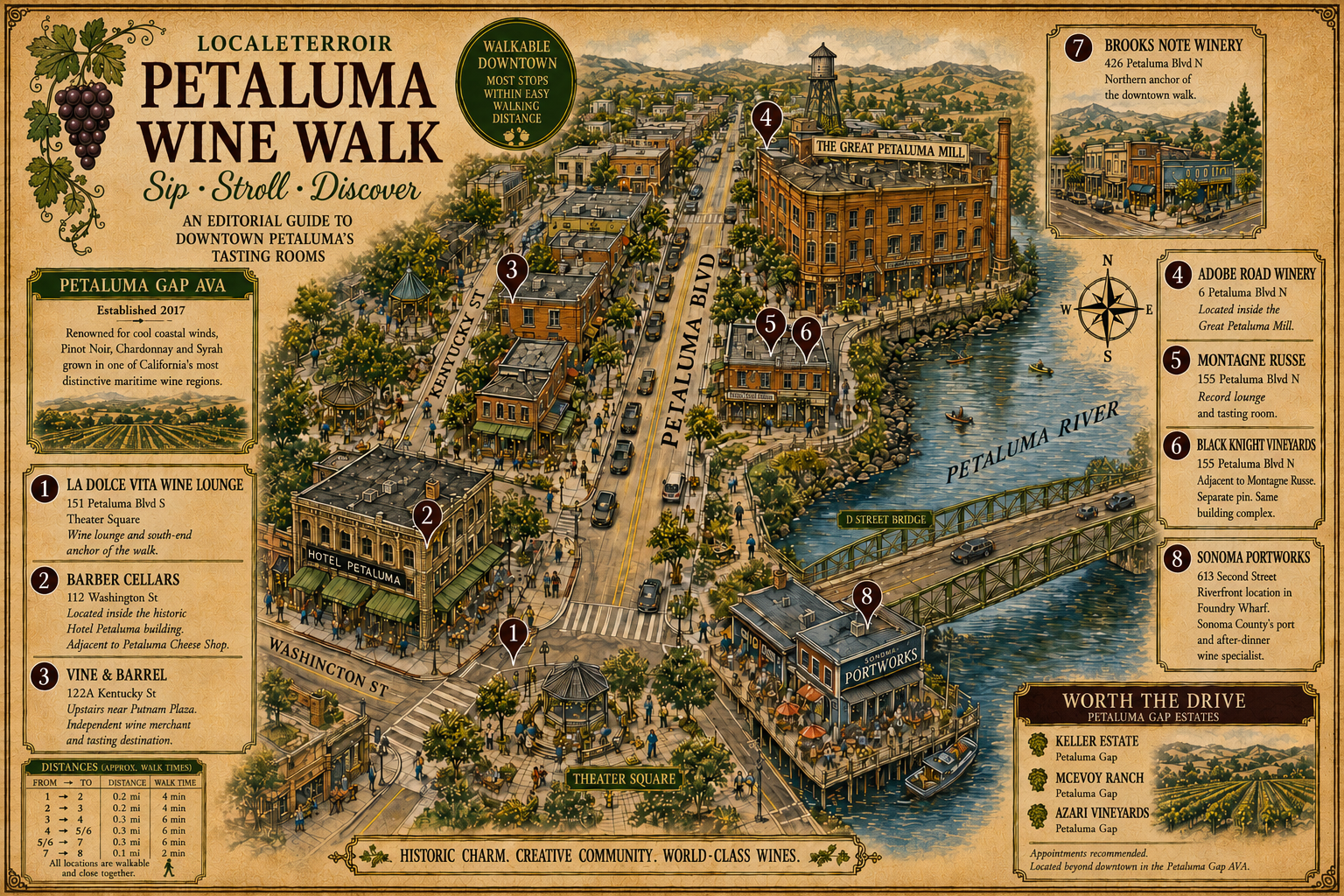
Established 2017 · Thermal wind corridor · Breach in Coast Range between Bodega Bay and San Pablo Bay · Wind-defined appellation · Silty clay loam and volcanic soils · Pinot Noir · Syrah · Petaluma and Sonoma County

Established 2023 · Narrowly defined coastal AVA · Only vineyards genuinely shaped by Pacific Ocean proximity qualify · Rocky ancient soils · Temperatures rarely exceed 70°F · Pinot Noir · Chardonnay · Occidental, Freestone, Bodega Bay area

Established 2012 · Coastal ridges 1,200–2,200 ft elevation · Above the fog line · Dramatic 50°F+ diurnal range · Thin rocky ancient soils · Pinot Noir · Chardonnay · Jenner and Cazadero area, Sonoma County

Established 1983 · Sonoma County · Healdsburg to Forestville · Westside Road · Middle Reach · Eastern Hills · Goldridge sandy loam, alluvial gravels, volcanic soils · Pinot Noir · Chardonnay · Zinfandel (Eastern Hills)

Established 1983 · Sub-AVA of Russian River Valley · Forestville and Graton area · Coldest and foggiest corner of RRV · Goldridge sandy loam soils · Shortest growing season in Sonoma · Pinot Noir · Chardonnay · Sparkling wine

Established 1983 · Sonoma County · Green Valley sub-AVA · Laguna Ridge · Sebastopol Hills · Santa Rosa Plain · Goldridge sandy loam · Coolest, foggiest corner of RRV · Pinot Noir · Chardonnay · Sparkling

Established 1983 · Enclosed valley between three ridgelines · Volcanic soils · Petaluma Wind Gap influence · Merlot · Syrah · Chardonnay · Santa Rosa, Sonoma County

Established 1983 · Northeastern edge of Russian River Valley · White volcanic ash soils · Warmer and more sheltered than RRV proper · Chardonnay · Sauvignon Blanc · Cabernet Sauvignon · Windsor area, Sonoma County

Established 1981 · Sonoma County's first AVA · Runs northwest-southeast from San Pablo Bay to Kenwood · Diverse elevations 0–2,000+ ft · Volcanic and alluvial soils · Cabernet Sauvignon · Zinfandel · Chardonnay · Pinot Noir

Established 2013 · Western slopes of Mayacamas Range · Elevations 400–2,000+ ft · Above the Sonoma Valley fog line · Ancient volcanic soils · Dramatic diurnal range · Cabernet Sauvignon · Zinfandel · Sonoma Valley, Sonoma County

Established 1985 · Western edge of Sonoma Valley · Above the marine fog line · Ancient volcanic soils · Warm days, cool nights · Cabernet Sauvignon · Zinfandel · Merlot · Glen Ellen and Kenwood area, Sonoma County

Established 1983 · 16 miles long, 1 mile wide · Benchland alluvial soils · Zinfandel and Sauvignon Blanc dominant · Old-vine heritage · Northwest of Healdsburg

Established 1984 · 22-mile valley · Russian River corridor · Warm to hot climate · Cabernet Sauvignon and Merlot dominant · Old-vine Zinfandel heritage · Healdsburg to Cloverdale

Established 1983 · Sonoma County · Warmest AVA in Sonoma · Volcanic and alluvial soils · Cabernet Sauvignon dominant · Borders Napa Valley to the east

Established 2015 · Volcanic hillsides above Santa Rosa · Elevations 400–2,000 ft · Above the marine fog line · Thin rocky volcanic soils · Named for 19th-century utopian community · Rebuilt after 2017 Tubbs Fire · Cabernet Sauvignon · Merlot · Cabernet Franc

Established 2002 · Nation's 145th AVA · Sonoma's 12th · ~160 acres planted across 11 vineyards · Elevation 800–2,100 ft · Zinfandel dominant · Above Lake Sonoma · Northwest corner of Dry Creek Valley

Established 2012 · Sonoma-Mendocino border · Elevations 1,600–2,700 ft · Volcanic soils · Cabernet Sauvignon and Bordeaux blends dominant · Extreme diurnal range
Oops! Something went wrong while submitting the form